Troutbirder

Troutbirder
To Go To Troutbirders Nature Blog (click on above picture)

Friday, September 28, 2018

Hundred Miles to Nowhere


Author/singer Elisa Korenne   tells a wonderful story in her memoir Hundred Miles To Nowhere. It’s the story of the New York City girl who meets a small town Minnesota guy. Being of the later type, I was naturally enthralled.  Elisa gets accepted to an artist residency in New York Mills, MN, and sees it as an opportunity to broaden her songwriting horizons. Looking for true to life Minnesota (fly over country Hicksville) experiences she starts by scheduling a wilderness canoe camping trip with  a local outdoorsy insurance man.  The fun part,   reading about their romance, is the contrasts of their two very different  worlds, how their relationship developed and was challenged by such different communities.

After her one month residency was up Elisa and Chris carried on with a mutual  cross-country romance and finally it was  Elisa who gave up subways, theater, City Bakery cookies, and her Brooklyn apartment to become the 1,153rd resident of New York Mills, a rural town ninety miles from the nearest metropolitan area, Fargo, North Dakota.  A few highlight/lowlights were the gossips who knew her weekend plans before she did. The postmaster who set up gigs for her behind her back. Chris expected her to eat roadkill for dinner. The the uproar when the Finnish Lutherans in town learned she was Jewish.  And the furnace dying at twenty-six below.  Regardless, Elisa moved to Minnesota and married Chris anyway.

I loved this book. It’s insightful, funny and draws you right into the predicament of being a transplant in different world.   My own experience growing up in the Twin Cities and spending my adult working life in rural Minnesota was not quite as dramatic but still I could relate. The old and new blend into  an evolving you.  Unafraid  you can meet the challenges and I believe see both the past and present circumstance of you, your life and surroundings much more clearly… I highly recommend this book…..
 

Click icon for more
book review blogs
@Barrie Summy

Saturday, July 21, 2018

Destiny of the Republic


He was born in poverty, in a log cabin, on the American frontier. Through hard work, and a wonderful ability to educate himself, courage and an expansive personality he rose to be President of the United States. No. No. It wasn’t Abe. His name was James Garfield. He was from Ohio and was our second president to be assassinated.
Candace Millard has written a wonderful description of an aspect of the age which saw the transition from the end of Reconstruction to modern America. Her book Destiny of the Republic - A Story of Madness, Medicine and the Murder of a President tells the story of a little known President, cut off like John Kennedy, in the prime of his life. It was a time of great corruption in government, "robber barons" and the solidification of segregation as part of southern institutions and thinking.
The most interesting part of the book is the story of how a man shot in the back with what should have been non mortal wounds was basically killed by his doctors.
Over a period of about 11 weeks the President was repeatedly probed into his wounds with unsterilized fingers and instruments as the doctors tried to find the bullet lodged in his body. This all at a time when the world famous French doctor, Joseph Lister, had been demonstrating for years how his theories on the prevention of infection could save lives and limbs. The famous American inventor, Alexander Graham Bell also worked furiously to develop a machine which could locate the bullet. All to no avail.
Millard, whose previous book The River of Doubt was about Theodore Roosevelt’s near-fatal journey of exploration in South America, is again perfect in bring these people and events to life. This book of narrative history ranks right up there with others like The Devil in the White City as a classic of its type. I highly recommend it.

Friday, June 29, 2018

History Redux

You might be surprised to learn that this fine stone home, overlooking the Missouri River near St. Charles, Mo. belonged to Daniel Boone. A few summers back we stopped to visit on our way to the Ozarks. I liked to imagine Boone sitting on the verdana as Lewis and Clarks's Corps of Discovery passed by at the botton of the hill. Historic homes can inspire the imagination and put you in a different era. I had those feelings in Springfield Ill. where Lincoln lived, Washington's Mt. Vernon and , of course, Montecello, Jeffersons home. And yet..... so many bedrooms and kitchens eventually made my eyes glaze over. Enough is enough.

That was pretty much my attitude when, along with Mrs. T and our friends Gary and Rosie, a trip was being planned to visit Great Smoky National Park and the Blue Ridge Parkway. Two days were included to visit America's premier colonial city - Williamsburg in Virginia. Hundreds of original building and homes. Endless kitchens, bedrooms and dining sets. Oh my!

Standing in the garden of the Governors Palace in Colonial Williamsburg, I heard a loud voice haranguing a small crowd on a street corner just outside the garden. As I approached, I heard the speaker advising his listeners that with "the Colonel" leading the colonial troops surrounding the British army in Boston, success was bound to follow. One member of the audience asked if their was no room for compromise. Disdainfully waving his hand aside, the speaker spoke of liberty and death. I looked quizzically at the man standing next to me. "It's Mr. Henry you know. He is quite the rabblerouser." Emboldened, I turned and asked Mr Henry if he felt Colonel Washington was "sufficiently qualified, given his lack of successful military experience, to undertake such a grave task?" Taken aback, Henry immediately attacked me for even casting the slightest aspersion upon such a "fine and upstanding Virginian." The crowd definitely agreed with that. "Where are you from," I was asked, as if that would explain my ignorance. "The Land of Sky Blue Waters, far to the northwest."

Properly chastened I followed my companions across the street to "tour" another house. We were welcomed by a tall elderly gentlemen who invited us to sit down and visit in the parlor. He said his name was Wyeth. He had the air of a professor or teacher about him. He was actually both and a lawyer as well.
Upon finding out we were all teachers and from " far to the West," he wondered if we were Papists. Satisfied on that point, we talked about students. Among his law students had been the aforemention Patrick Henry and a Thomas Jefferson. I couldn't resist asking him how they compared as students. He laughed and said both had attained the bar but " Jefferson was easily the most brilliant student I had ever taught. Henry, on the other hand, well lets just say, I'm sure he talked his way into it."

Later, we attended a session of the House of Burgesses, met Mrs. Washington who was speaking to a group of Girl Scouts in a home she was visiting. She also graciously answered some of our questions. We met some regular people going about their business. All in all what this all amounts to is part history lesson and part Disney-style razzmatazz. The museum focuses on events in the town during the painful divorce from Britain, via re-enactments of some of the key incidents. Thus you get to see the 'local people' gathering at the Governors Palace to hear a reading of the Declaration Of Independence, congregating outside the Raleigh Tavern to hear news of the war, or conducting recruitment drives (among the paying visitors) for Washington's army. I loved it. This was living history....the best kind.

Tuesday, June 5, 2018

Cold Mountain


Cold Mountain by Charles Frazier

On the theory of “better late than never” having just read and reviewed Frazier’s Verona and duly impressed with his writing skillsm I checked our local library to see what else he had written.  Thus, I came upon Cold Mountain. I recognized the title from an Academy Award winning movie I had missed seeing…..
 
 Published twenty some years ago, this now widely read debut novel was at the top of best seller lists for over a year. It also won many literary awards.
 Badly wounded and disillusioned finally realizing the war was mainly to preserve slavery for the rich, a Confederate soldier named Inman decides to walk back to his home in the Blue Ridge Mountains to Ada, the woman he loves. His trek across the disintegrating South brings him into intimate and sometimes lethal converse with slaves and marauders, bounty hunters and eccentrics some helpful and others dangerous.  At the same time, highly educated for the times Ada is trying to revive her father’s derelict farm and learning to survive in a changing  world she is ill prepare to deal with.  Alternating chapters connect their stories.  The lyrical descriptions of the Appalachians set the scenes as the author gives us  a powerful story of real life circumstances. It might not be too far of a stretch to say that Ulysses and Penelope came to mind as I was drawn into this wonderful book. I highly recommend it.....

Click icon for more
book review blogs
@Barrie Summy

Wednesday, May 30, 2018

Wednesday, May 2, 2018

Varina


Varina by Charles Frazier

Whether its history, biography or historical fiction the devastation of the American Civil War is widely read and known about but not always and not about  everyone who was there.  Charles Frazier, author of best seller Cold Mountain, takes us back to those awful days and introduces us to a teenage girl who lived surrounded by the people, events and consequences of that awful war.

Her name is Varina Howell.  With a financially reckless father she agrees to wed the much-older widower Jefferson Davis, perhaps giving her stability and the ability to help her parents. Davis is a wealthy Mississippi planter and slaveholder.   Davis pursue politics and Varina find herself in Washington  where he husband is a key figure as a Congressman and leading figure in several administrations.

   Davis is eventually appointed president of the Confederacy, putting Varina in the middle of things. For Civil War “buffs” the details of the war as seen thru Varinas life  will likely not reveal much that is new. It is her life, experiences and thoughts that grab the reader.  The Confederacy falling, her marriage in tatters,  her rescue of a black child being beaten on the street of Richmond, later raising that boy with her own children is only the beginning. Later she and her children escape Richmond and travel south on their own, now fugitives with “bounties on their heads, an entire nation in pursuit.” This is the story of  one woman’s tragic life and is epic in its breadth and intimacy.

Because her twilight years were more interesting to Frazier, he decided against using a traditional biographical approach to tell Davis’ story. This bothered me at first. I like and need chronology to keep track of things in any story. I’ll let the author explain in his own words…

“I decided early on that I didn’t want the structure to be based on the calendar,” he said. “I wanted it to be based on memory and association. I wanted that back and forth, push and pull, jumping through time.”To reveal her tale, Frazier drew on a real person from her past. During the last year of the war, the Davis family took in a young mixed-race boy and raised him with their children. That boy, known as Jimmy Limber, was taken away when the family was captured by Union soldiers as they tried to flee to Cuba. He never saw Varina Davis again. And his fate remains a mystery. For his  novel, “Varina,” Frazier creates James Blake, the adult version of that boy. Blake, who is a teacher, becomes the book’s driving force as he tracks Davis down and pushes her to help him understand his past.

The book’s chapters alternate between the two adults and Davis’ life in New York and flashbacks that reveal her childhood, her marriage and particularly the harrowing journey she and her children took as they fled Richmond after the Confederacy collapsed. The narrative jumping around can be frustrating at first but in the end the reader realizes that this is an exploration of  Varinas memories, her feeling of complicity and realizations of the moral depravity of slavery and it consequences in her own life.

Having previously read and reviewed the story of the Grimke sisters (The Invention of Wings by Sue Monk Kid   ) this book was an interesting counterpoint.  Varina is a feminist in her own right. She is conflicted. She made  tough choices. And most interestingly was and is still denigrated by those who wish her husbands cause had prevailed….This is a most fascinating and revealing novel/ biography. I highly recommend it.....
 
br />
Click icon for more
book review blogs
@Barrie Summy

Saturday, April 21, 2018

The Last Lion: Defender of the Realm


The Last Lion: Winston Churchill  is a trilogy of biographies covering the life of Winston Churchill. The first two were published in the 1980s by author and historian William Manchester, who died while working on the last volume. However, before his death, Manchester had selected Paul Reid to complete it  the final volume...
 
The Last Lion: Defender of the Realm was published in November 2012.
"[Reid's] palpable enthusiasm at thinking about Churchill demonstrates once again...the grip this iconic figure can still exercise on the imagination....Reid...use[s] his journalist's eye to pick up on small details or points of color that illustrate a wider truth." (Richard Aldous, New York Times Book Review )
"Mr. Reid...following Manchester's lead,...dutifully includes both the admiring and disparaging remarks of Churchill's colleagues and contemporaries, presenting everyone's take with equanimity." (Wall Street Journal )
"Reid has produced a third Last Lion...that is both magisterial and humane. Cue the trumpets." (Vanity Fair )
"It's a must-read finale for those who loved Manchester's first two books." (USA Today )
"Masterful... [and] breathtaking....Reid...finished the race with agility, grace, and skill....This is a book that is brilliant and beautiful, evocative and enervating." (Boston Globe )
"Those who want a detailed account of Churchill's two terms as prime minister and leadership during World War II will find this book a literary feast.....It's a worthy finale to an exhaustive portrait of one of the last century's true titans." (Washington Times )
Reid has written a thorough and complete analysis of these years, and it is a worthy finale to the first two volumes." (Terry Hartle, Christian Science Monitor )
"The third and final volume of a massive work of biography is a tribute not only to Manchester but also to Reid, whose courage in accepting the job is matched by his success in telling the story." (Richmond Times-Dispatch )

Troutbirder writes “I really enjoyed this book!  Was the writing as brilliant and engaging as that of William Manchester?  No, but then not everyone can  do A+. This was more like B+ but still worth it.”
About the Authors
William Manchester was a hugely successful popular historian and biographer whose books include The Last Lion, Volumes 1 and 2, Goodbye Darkness, A World Lit Only by Fire, The Glory and the Dream, The Arms of Krupp, American Caesar, The Death of the President, and assorted works of journalism.
Paul Reid is an award-winning journalist. In late 2003 his friend, William Manchester, in failing health, asked Paul to complete The Last Lion: Defender of the Realm. 
On the lighter side you can scroll back to the top and click on the picture of the guy in the pink shirt and Minnesota Gopher hat to other blog and some ripostes from Winston Churchill.....:) 


Tuesday, April 17, 2018

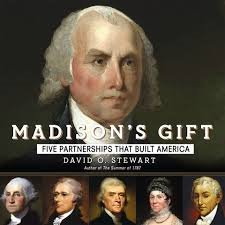
Madisons Gift


Historian and novelist Stewart  gives American a needed lesson on how a President can accomplish much by working with others.  It was James  Madison’s ability to forge working bonds with other founding members of the new American government, even if they did not always see eye to eye that stands out in this biography.  Discreet, generous and not at all egotistical, unlike others then and now he dit much to forge the documents that framed a new government, He refused to take credit, rather conceding the “work of many hands and many heads” in the forging of the Constitution.  Soft-spoken, he was overshadowed by the more dynamic personalities of George Washington, Thomas Jefferson, Alexander Hamilton and James Monroe.  Yet the complement of their respective qualities resulted in brilliant working relationships during the course of Madison’s political career.

A wonderful biography of a very smart President.  Let us hope we shall see his like again. We surely could use it in these very different times….
 

Monday, April 2, 2018

The Invention of Wings


The Invention of Wings by Sue Monk Kidd
 
In simple terms, the book is the fictionalized history of the Grimké sisters, Sarah and Angelina (Nina), who were at the forefront of the abolitionist and women's rights movements in its early beginnings before the Civil War. As young girls and women they grew up on a slave holding plantation in South Carolina.   In alternating chapters  is the intriguing narrative of Sarah and a young slave, Hetty, who was given to Sarah as an 11th birthday present. Sarah despises slavery, even at that early age, and out of principle attempts to reject the gift.

Much of the Grimkés' story is historically based: Kidd has fleshed out mountains of research — facts, figures, dates, letters, and articles — into a believable and elegantly rendered fictional first person account of Sarah's life. But though Hetty was real, her story here is almost entirely fabricated — and perhaps because she is mostly a product of Kidd's imagination, Hetty's character seems truly inspired.

A key moment in the book comes with the discovery that Sarah has taught Hetty to read — a criminal offense in antebellum South Carolina. Punishment is cruel for both girls; Sarah is banned from her favorite things in the world: her father's library and his books. Hetty is whipped.

Meanwhile, Sarah's family ridicules her hope to study law, labeling it unseemly because she is a woman. She is shattered and cowed by their conviction that being a woman means she has no right to ambition. Overcoming that obstacle is a long, painful journey full of self-doubt; she'll face prejudice toward her sex the rest of her life, even as she eventually  creates a national following for her abolitionist crusade. Sarah may read, think, or speak — as long as she doesn't make any men uncomfortable by doing so. Her younger sister is also highlighted.  Sarah is the thinker. Her younger sister Nina is the doer.  They make a great team.

I would strongly suggest that your read the author’s comments at the end of this wonderful novel before starting on the book story itself. It’s fascinating and will help clarify where historical facts and the author imagination stand. I also found it interesting that the author tells how she ran across the Grimke sisters story  in a Chicago exposition of “one hundred of the most influential women in American History.” The two sisters certainly deserved much more notice in the annals of American History textbooks than they ever received. For my part between 1964 and 2004 when I taught units on the people and events leading up to the Civil War to high school students I always included their neglected story. Now I’m every glad that Kidd, a wonderful writer,  has brought that story to a much wider audience. I strongly recommend it to everyone…


Click icon for more
book review blogs
@Barrie Summy