Troutbirder

Troutbirder
To Go To Troutbirders Nature Blog (click on above picture)

Sunday, July 29, 2012

Conquest - The English Kingdom of France

In the words of Juliet Barker the author of Conquest The English Kingdom of France.
Juliet says: "The most difficult thing about writing a book is usually finding the subject, especially after a major success like Agincourt. I had toyed with the idea of writing about Joan of Arc but my publishers said they wanted to know what happened after the battle of Agincourt and I realised I didn’t know myself. My knowledge of the period ended with Henry V so I was aware that he had invaded France a second time, conquered much of northern France and forced Charles VI to recognise him as his heir. After that, I realised I had only the vaguest notion of what had occurred. In fact I’m ashamed to admit that I thought the English were expelled from France as a result of Joan of Arc’s appearance on the scene. It was therefore a major revelation to me to discover that she was just a blip in the story of the English occupation which continued for another twenty years – twice as long as before her arrival.It was only after I began my research that I discovered that I was treading new ground: amazingly, there has never been a narrative history dedicated to the last thirty years of the Hundred Years War. This gave me a major headache in that I had to create a chronological structure out of a huge number of conflicting sources and I often found that I had to rewrite passages in the light of newly discovered information. On the other hand, I had a wealth of new material describing not just the epic battles and sieges but also the personal stories of those who defended the English kingdom of France and those who lived under occupation.What fascinated me – as with Agincourt – were these human stories which remind us that that these were real people no different to ourselves. The poor French girl Jehanette Roland, for instance, who fell in love with an English herald and was all set to marry him just at the point when Charles VII reconquered Paris: the new government forcibly intervened to separate them, insisting that marriage with the enemy could not be allowed. Or Robert Stafford who complained that it was impossible for him to defend his fortress since his sole gunner was absent, the only cannon was in need of repair and there was just one crossbow left in the armoury – and that had no string. In our own time there is a horrible familiarity in the plight of those on the ground, fighting and often giving their lives to defend the English kingdom of France whilst denied the men, money and equipment they needed by the politicians who had sent them there in the first place. Conquest tells an extraordinary story – and one that ought to be remembered." What the cover says: In her best-selling Agincourt, Juliet Barker gave us the definitive narrative of Henry V’s extraordinary victory over the French. Now, in Conquest, she tells the equally remarkable, but largely forgotten, story of the dramatic years when England ruled France at the point of a sword.
Troutbirder says.... "well done."

Monday, July 23, 2012


Former Secretary of State Madeliene Albright writes of her childhood, family and the tortured history of the land of her birth- The Czech Republic, in her new book Prague Winter. It was only recently that she found out that most of her relatives were killed in the Holocaust. Her parents, who escaped in the early phases of WWII,chose not to tell anyone of their Jewish ancestry...
I found this book to be the best personal memoir I had read in years.

Friday, June 8, 2012

The Presidents Club

Once in a while our local librarian (and a former student) notifies me of the arrival of a new book she thinks I might enjoy. Thus I received a copy of The Presidents Club by Nancy Gibbs and Michael Duffy. It's one of the most exclusive clubs in the world, usually boasting only six or fewer members. This club has only one requirement for membership: having served as President of the of the United States. I must admit I was a little skeptical at first. Another Washington political potboiler filled with rumor, speculation about motives and unsubstantiated so-call "facts". Not at all. The Presidents Club is a clear and well-written glimpse into the modern presidency. It's worth reading and rereading for its behind-the-scenes insights.
It all began with Harry Truman bringing Herbert Hoover back from the limbo of being assigned the entire blame for the Great Depression. Hoover was given the job of unscrambling the bureaucratic logjam block food aid to a hungry and war torn Europe after World War II. This was exactly the same service he had successfully performed for President Wilson after World War II. A working relationship and even friendship ensued between the two men that in spite of future up and downs among future presidents set up pattern for the "club." The authors proceeded to explore how the relationships between former chief executives of often very different ideologies and politics have shaped history. I found these relationships sometimes petty and even distasteful but quite often inspiring. That was particularly so in these ideologically rigid and highly polarized times.
The sourest note in the whole book for me was to learn what a truely amoral, even immoral man, Richard Nixon proved to be. This relates to the story of Nixon's actions during the '68 presidential campaign, his successful effort to kill President Johnson's desperate hope for talks in Paris to end the Vietnam war in 1968. And Humphrey's well intentioned but mistaken decision not to publicly incriminate Nixon as a traitor to his country. The vicious block thrown by Nixon and his henchmen, including the go-between, Madame Chenault, prolonged the war for seven years. LBJ, knowing from secret wiretaps, that Nixon, through Chenault, was double dealing, phoned Nixon and appealed to him not to endanger the peace effort. "Oh no, Mr. President, said Nixon to LBJ, I would never do anything like that." Thousands more Americans died in Vietnam in the succeeding years.

Monday, June 4, 2012

A Dead Duck


Meanwhile, the big story was happening in Embarrass, MN (where else!), where a distraught woman brought her pet, a very limp duck – an Aflac look-a-like – into a veterinary surgeon.The vet laid the pet on the table, then pulled out his stethoscope and listened to the bird's chest.After a moment or two, the vet shook his head sadly and said, "I'm sorry, your duck has passed away."The distressed woman wailed, "Are you sure?""Yes, I am sure. The duck is dead," replied the vet."How can you be so sure?" she protested. "I mean you haven't done any testing on him or anything. He might just be in a coma or something."The vet rolled his eyes, turned around and left the room.He returned a few minutes later with a black Labrador Retriever.As the duck's owner looked on in amazement, the dog stood on his hind legs, put his front paws on the examination table and sniffed the duck from top to bottom.He then looked up at the vet with sad eyes and shook his head.The vet patted the dog on the head and took it out of the room.A few minutes later he returned with a cat. The cat jumped on the table and also delicately sniffed the bird from head to foot. The cat sat back on its haunches, shook its head, meowed softly and strolled out of the room. The vet looked at the woman and said, "I'm sorry, but as I said, this is most definitely, 100% certifiably, a dead duck." The vet turned to his computer terminal, hit a few keys and produced a bill, which he handed to the woman.The duck's owner, still in shock, took the bill. "$550!" she cried. "$1550! – just to tell me my duck is dead!" The vet shrugged, "I'm sorry. If you had just taken my word for it, the bill would have been $20, but with the Lab Report and the Cat Scan, it's now $1550."And that’s the way it is!


btw... I'm off to the Mayo Clinic next week for some tests. Maybe I should bring Baron and Simba.... :)

Tuesday, May 29, 2012

Interviewing Mark Twain

Flyfishig today? Too windy. Birding today? Too windy. Tree limb trimming today? Too windy. Instead, today, I had time to reflect upon a recent conversation I had with well known author and humorist Mark Twain. I had met him during a recent trip to Dubuque, Iowa. Mark Twain wrote hundreds of comments about the nature and cause of humor. This quote reflects my own view.
"What is it that strikes a spark of humor from a man? It is the effort to throw off, to fight back the burden of grief that is laid on each one of us. In youth we don't feel it, but as we grow to manhood we find the burden on our shoulders. Humor? It is nature's effort to harmonize conditions. The further the pendulum swings out over woe the further it is bound to swing back over mirth." - Interview in New York World Sunday Magazine, November 26, 1905 Troutbirder - Actually, I’m from Minnesota, MarkMark Twain - I was there one winter a few years back and cold! If the thermometer had been an inch longer we'd all have frozen to death.
Troutbirder - It’s my birthday tomorrow and I must admit I’m feeling my age!Mark Twain - Age is an issue of mind over matter. If you don't mind, it doesn't matter.Troutbirder - On a serious note you probably know that we have been fighting in Iraq for many years now because of their weapons of mass destruction and support of the Muslim terrorists. Mark Twain -Statesmen will invent cheap lies, putting blame upon the nation that is attacked, and every man will be glad of those conscience-soothing falsities, and will diligently study them, and refuse to examine any refutations of them; and thus he will by and by convince himself that the war is just, and will thank God for the better sleep he enjoys after this process of grotesque self-deception.Troutbirder - But Sir, what about patriotism? Mark Twain - Patriotism is supporting your country all the time, and your government when it deserves it.


Also, after meeting him, Mrs Troutbirder pointed out - "I think we could have used a few more wise men in recent years like Mr. Twain'

Saturday, May 26, 2012

Memorial Day

Memorial Day
We few, we happy few, we band of brothers:
For he today that sheds his blood with me
Shall be my brother
-SHAKESPEARE, HENRY V
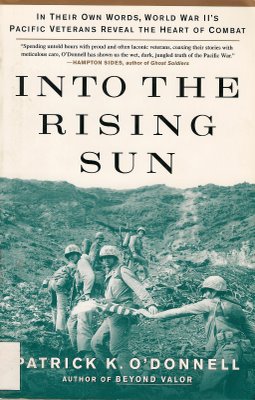
It seemed fitting to finish reading this book here right before Memorial Day. Not a chronology or historical analysis of this oft written about war, instead O'Donnel has given us personal stories of the experiences of combat veterans in their own often reluctant words. Into The Rising Sun is the truth about this most brutal of wars in the American experience.
O'Donnel focuses on the elite troops who lead the way into the Pacific War. They were the Raiders, Paratroopers, Rangers, and Marauders. He writes that "the war remains a defining part of their lives. Refracted through memories that are now nearly sixty years old, a part of them is still in places they fought. They remember those who never returned. Some are still unable to talk about their experiences. Time and age have thinned their ranks. Every battalion or division has a newsletter that contain a roll of those who have passed, a list that grows longer with each month. The yearly reunions get smaller. But neither time no age can diminish their love for one another."
We honor their sacrifice with our loving rememberance on this and every Memorial Day

Sunday, May 20, 2012

Two Americans: Truman, Eisenhower And A Dangerous World


I just finished reading Two Americans. It is a comparison of the origins and careers of two presidents from the middle of the 20th century. Truman and Eisenhower, an army officer and a politician in their fifties, they were unknown nationally when World War II began . With similar conservative small town middle American backgrounds, their knowledge of American society was heavily impacted by their careers. Eisenhower live an almost monastic life, sheltered from the hurly burly of every day contact with regular people by the army. Truman, in farming, business and then local politics knew people at that level. .
Distinguished historian Miller (President Lincoln: The Duty of a Statesman, 2008, etc.) offers lively, well-presented parallel biographies. The author is primarily interested in comparing the experiences of these two men as they rose through the ranks of their chosen professions, and their approaches to government as exemplified by several specific issues: McCarthyism, in which neither president distinguished himself; civil rights, in which Miller finds Eisenhower severely wanting despite his use of troops in Little Rock; and their attitudes toward the possible use of tactical and strategic nuclear weapons.
Miller delights in telling stories. And they are good stories about the greatness as well as the pettiness of two seemingly ordinary Americans vaulted by circumstances beyond their dreams, stories told affectionately with insight and sensitivity, messages ringing with relevance for us today. The author has a conversational and easy to read style. I thoroughly enjoyed reading this book....

Monday, May 14, 2012

Peter Yarrow

Peter Yarrow (born May 31, 1938) is an American singer who found fame with the 1960s folk music trio Peter, Paul and Mary. Yarrow co-wrote one of the group's most famous songs, "Puff, the Magic Dragon." He is also a political activist and has lent his support to causes that range from opposition to theVietnam War to the creation of Operation Respect. In 1962, the trio's first album, Peter, Paul & Mary was released. The album sold more than two million copies. The group toured extensively and recorded numerous albums, both live and in the studio. In October 1969, Yarrow married Mary Beth McCarthy of Willmar Minnesota. Paul wrote The Wedding Song (There is Love)" as his gift for their wedding and first performed it at St. Mary's Church in Willmar. He has two adult children. In 2000, he founded Operation Respect.
On behalf of Operation Respect, Yarrow has appeared, pro bono, in areas as diverse as Hong Kong, Vietnam, Bermuda, Croatia, South Africa, Egypt, Argentina and Canada. In all, the program has been presented to many educational leaders and more than 10 million children. In some form, the project has reached nearly a of all elementary and middle schools in America; at least 20,000 schools, in all.
Although Mary has left us from the effects of cancer, it was a special moment to be able to attend a Yarrow concert last Saturday night in Rochester Minnesota. The sense of love and community was still there and the music... oh the music. In contrast to the greed, arrogance and "me" of today one can’t help but wonder "where have all the flowers gone?"

Wednesday, May 9, 2012

Cain At Gettysburg by Ralph Peters

Gettysburg, the greatest battle ever fought in North America, saw two American armies slaughter each other at an unbelievable cost of human life and limb. Thousands of books have been written about it. Peters new novel, historically accurate, plumbs the human side from generals to common soldiers. It is carefully crafted by a skilled author who takes readers far beyond a mere non-fiction account of the battle. It makes you feel like you were really there on those fateful three days.
In his Author’s Note, Peters judges that "A novel about Gettysburg for our time must demonstrate war’s horror and appeal, while depicting the complex humanity of those who shoulder rifles or lead armies." In Cain at Gettysburg he clearly accomplishes that. In a different way this book surpasses the – until now – best-known, most widely read novel on the battle, Michael Shaara’s The Killer Angels (1974). That book written in the 70's era of particularly low esteem for all things military, provided a romanticism that was needed for a nation that seemingly had turned its back on the idea of heroes. Now we can read of the battle as it surely must have been experienced by those who fought it. In the course of the book, Peters "rehabilitates" several leaders such a George Meade, new commander of the Army of the Potamac, and "Old Pete" Longstreet who was Robert E. Lee’s top surviving General and repeatedly advised the Souths hero against a foolish frontal attack at Gettysburg.
For example, from J.D. Morelock in the magazine Armchair General, "Despite winning this major turning point battle – and thereby becoming the first Union general to beat the Army of the Potomac’s arch nemesis, Confederate General Robert E. Lee – Meade was much maligned by some self seeking Union generals jealous of his Gettysburg triumph and by, as Peters’ writes, "Southern chroniclers [who] could not forgive him for defeating Robert E. Lee in a fair fight." Peters’ insightful examination in Cain at Gettysburg of Meade’s character, the daunting challenges he faced when command of the Army of the Potomac was thrust upon him on the eve of the battle and his command of the battle reveals the true accomplishments of the Victor of Gettysburg. Peters’ final judgment of Meade in the novel’s Epilogue seems spot on:
"Fatally, [Meade] was not a political general and had little patience with newspapermen – with the result that he was damned by partisan scribblers or, when not attacked, ignored in favor of self-promoters and liars. The man who grasped the reins of an army literally overnight and saved the Union in the course of three desperate days of battle was demoted in the public mind to a drab second-rater, his victory credited to his subordinates. It was the worst injustice ever done to an American general."