Troutbirder

Troutbirder
To Go To Troutbirders Nature Blog (click on above picture)

Saturday, May 26, 2012

Memorial Day

Memorial Day
We few, we happy few, we band of brothers:
For he today that sheds his blood with me
Shall be my brother
-SHAKESPEARE, HENRY V
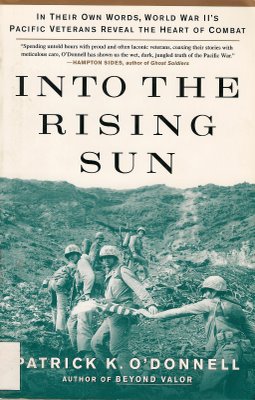
It seemed fitting to finish reading this book here right before Memorial Day. Not a chronology or historical analysis of this oft written about war, instead O'Donnel has given us personal stories of the experiences of combat veterans in their own often reluctant words. Into The Rising Sun is the truth about this most brutal of wars in the American experience.
O'Donnel focuses on the elite troops who lead the way into the Pacific War. They were the Raiders, Paratroopers, Rangers, and Marauders. He writes that "the war remains a defining part of their lives. Refracted through memories that are now nearly sixty years old, a part of them is still in places they fought. They remember those who never returned. Some are still unable to talk about their experiences. Time and age have thinned their ranks. Every battalion or division has a newsletter that contain a roll of those who have passed, a list that grows longer with each month. The yearly reunions get smaller. But neither time no age can diminish their love for one another."
We honor their sacrifice with our loving rememberance on this and every Memorial Day

Sunday, May 20, 2012

Two Americans: Truman, Eisenhower And A Dangerous World


I just finished reading Two Americans. It is a comparison of the origins and careers of two presidents from the middle of the 20th century. Truman and Eisenhower, an army officer and a politician in their fifties, they were unknown nationally when World War II began . With similar conservative small town middle American backgrounds, their knowledge of American society was heavily impacted by their careers. Eisenhower live an almost monastic life, sheltered from the hurly burly of every day contact with regular people by the army. Truman, in farming, business and then local politics knew people at that level. .
Distinguished historian Miller (President Lincoln: The Duty of a Statesman, 2008, etc.) offers lively, well-presented parallel biographies. The author is primarily interested in comparing the experiences of these two men as they rose through the ranks of their chosen professions, and their approaches to government as exemplified by several specific issues: McCarthyism, in which neither president distinguished himself; civil rights, in which Miller finds Eisenhower severely wanting despite his use of troops in Little Rock; and their attitudes toward the possible use of tactical and strategic nuclear weapons.
Miller delights in telling stories. And they are good stories about the greatness as well as the pettiness of two seemingly ordinary Americans vaulted by circumstances beyond their dreams, stories told affectionately with insight and sensitivity, messages ringing with relevance for us today. The author has a conversational and easy to read style. I thoroughly enjoyed reading this book....

Monday, May 14, 2012

Peter Yarrow

Peter Yarrow (born May 31, 1938) is an American singer who found fame with the 1960s folk music trio Peter, Paul and Mary. Yarrow co-wrote one of the group's most famous songs, "Puff, the Magic Dragon." He is also a political activist and has lent his support to causes that range from opposition to theVietnam War to the creation of Operation Respect. In 1962, the trio's first album, Peter, Paul & Mary was released. The album sold more than two million copies. The group toured extensively and recorded numerous albums, both live and in the studio. In October 1969, Yarrow married Mary Beth McCarthy of Willmar Minnesota. Paul wrote The Wedding Song (There is Love)" as his gift for their wedding and first performed it at St. Mary's Church in Willmar. He has two adult children. In 2000, he founded Operation Respect.
On behalf of Operation Respect, Yarrow has appeared, pro bono, in areas as diverse as Hong Kong, Vietnam, Bermuda, Croatia, South Africa, Egypt, Argentina and Canada. In all, the program has been presented to many educational leaders and more than 10 million children. In some form, the project has reached nearly a of all elementary and middle schools in America; at least 20,000 schools, in all.
Although Mary has left us from the effects of cancer, it was a special moment to be able to attend a Yarrow concert last Saturday night in Rochester Minnesota. The sense of love and community was still there and the music... oh the music. In contrast to the greed, arrogance and "me" of today one can’t help but wonder "where have all the flowers gone?"

Wednesday, May 9, 2012

Cain At Gettysburg by Ralph Peters

Gettysburg, the greatest battle ever fought in North America, saw two American armies slaughter each other at an unbelievable cost of human life and limb. Thousands of books have been written about it. Peters new novel, historically accurate, plumbs the human side from generals to common soldiers. It is carefully crafted by a skilled author who takes readers far beyond a mere non-fiction account of the battle. It makes you feel like you were really there on those fateful three days.
In his Author’s Note, Peters judges that "A novel about Gettysburg for our time must demonstrate war’s horror and appeal, while depicting the complex humanity of those who shoulder rifles or lead armies." In Cain at Gettysburg he clearly accomplishes that. In a different way this book surpasses the – until now – best-known, most widely read novel on the battle, Michael Shaara’s The Killer Angels (1974). That book written in the 70's era of particularly low esteem for all things military, provided a romanticism that was needed for a nation that seemingly had turned its back on the idea of heroes. Now we can read of the battle as it surely must have been experienced by those who fought it. In the course of the book, Peters "rehabilitates" several leaders such a George Meade, new commander of the Army of the Potamac, and "Old Pete" Longstreet who was Robert E. Lee’s top surviving General and repeatedly advised the Souths hero against a foolish frontal attack at Gettysburg.
For example, from J.D. Morelock in the magazine Armchair General, "Despite winning this major turning point battle – and thereby becoming the first Union general to beat the Army of the Potomac’s arch nemesis, Confederate General Robert E. Lee – Meade was much maligned by some self seeking Union generals jealous of his Gettysburg triumph and by, as Peters’ writes, "Southern chroniclers [who] could not forgive him for defeating Robert E. Lee in a fair fight." Peters’ insightful examination in Cain at Gettysburg of Meade’s character, the daunting challenges he faced when command of the Army of the Potomac was thrust upon him on the eve of the battle and his command of the battle reveals the true accomplishments of the Victor of Gettysburg. Peters’ final judgment of Meade in the novel’s Epilogue seems spot on:
"Fatally, [Meade] was not a political general and had little patience with newspapermen – with the result that he was damned by partisan scribblers or, when not attacked, ignored in favor of self-promoters and liars. The man who grasped the reins of an army literally overnight and saved the Union in the course of three desperate days of battle was demoted in the public mind to a drab second-rater, his victory credited to his subordinates. It was the worst injustice ever done to an American general."

Monday, April 30, 2012

Inferno

Inferno - The Epic Life and Death struggle Of The USS Franklin In World War II by Joseph A. Springer. In the early morning hour of March 19, 1945, just fifty-five miles south of Japan, a lone Japanese aircraft dropped from the clouds over the American fleet and trageted the aircraft carrier USS Franklin with a single bomb. "Big Ben" was about to become "the ship that wouldn't die," a nickname earned through fire and blood as she shuddered for an hour and a half under the explosions of her own ordnance that had been triggered by the bombing. Many of the crew not immediately killed in the explosions were blown overboard, driven off y fire, or wounded, a source of myriad heroic tales of survival. The officers and enlisted men left aboard the faltering ship (and those allowed to rejoin her later) were able to save her through sheer valor and tenacity. The enemy aircraft was shot down and disappeared into the sea, but Franklin remained afloat, against all odds and with casualties totaling 798 killed and more that 487 wounded - one of the most harrowing and amazing ordeals of any American carrier. This is her riveting story, from start to finish, in the eloquent and sometimes emotional words of the men who served aboard her.


I knew one of them Jim Erredge - AerM 1/c7 CV 13. He was a faculty member (adult agriculture) at the high school in Spring Valley, MN. where I began my teaching career. He was a member of the 704 Club. That is the number of sailors and airmen, out of a total of over 3,000, who managed to remain aboard the ship during the epic fight to keep it afloat. This is a great and telling book about naval warfare and that Greatest Generation who brought this country to victory in the Pacific War.

Sunday, April 22, 2012

A Crooked Number

Ok rant first. Today eblog said it wouldn't work for me until I "upgraded" my browser preferably to Google something. I don't like being pushed and I don't like improvements that are required to make me technological updated and more complicated. Grrrrr. So now I've wasted hours and don't think this new system is any better...... I'm not a happy camper!

My latest reading is Nathan Jorgensons A Crooked Number. This is the authors third novel. Again he spins a unique powerful yarn about the human condition. A Crooked Number chronicles the relationship of freshman dental student Grant Thorson and Professor Kate Bellows. Jorgenson weaves the themes young love, graduate school, and amateur baseball into a rich and tender coming-of-age story. The novel begins when Grant is smitten with a beautiful professor and asks her out on a date - to a baseball game. It is the story of friendship, love, and all of those forks in the road that lead young people to the best part of their lives.
The book is a prequel to Waiting for White horses which I loved and reviewed here http://troutbirder.blogspot.com/2012/01/ waiting-for-white-horses.html. That book featured a bunch of endearing characters that hooked me right away. The fact that it centered on a venue Minnesotas great outdoors and hunting and fishing didn’t hurt either A Crooked Number features more things in common with my own experience such as my alma mater, the University of Minnesota and my favorite sport, baseball.
From a small town in northwestern Minnesota, Grants goes off the dental school at the University of Minnesota . There he met Kate Bellows a young beautiful intelligent and mysterious professor. "A Crooked Number" is about Grant Thorson, a boy who grows up on a farm outside Halstad, Minn., goes on to a successful career as a dentist and an equally satisfying hobby of playing "town ball" baseball played a by a bunch of men who can’t give up the game. In more modern parlance Grant is a really "sensitive" guy. Your know, the kind you find in "chick flics" and Victorian novel where he is the choice compared to the "bad" guy who the women doesn’t realize is bad. He is also somewhat of a jock and there is a lot of tasteless male banter (in my view, being the sensitive type myself...:) All in all it’s a fun and interesting book to read, just not quite as good as Waiting For White Horses.

Monday, April 16, 2012

Enemy At The Gates


I don’t usually read a book or watch a movie more than once but exceptions can be made. I was laying in a hospital bed two days after my knee replacement surgery. Then they began withdrawing the intravenous pain killer. The knee ( now a fake one) didn’t hurt anymore, thank god, but the slightest turn and the my thighs cramped up like a bad charley horse. Ouch. For distraction there was a cable TV movie channel. I began watching a movie. In the face of German bombers, fighters and artillery and forced at gunpoint by the secret police, young Red Army soldier crossed the Volga in barges. They headed into surrounded and burning Stalingrad. I was captivated, enthralled and horrified at the overwhelming scenes.... They kept repeating the movie. I watched it three times.
Enemy at the Gates: The Battle for Stalingrad by William Craig is a spellbinding account, based on personal reminiscences, of the battle that turned the tide against the previously undefeated Nazi juggernaut. It inspired the 2001 movie of the same name starring Joseph Fiennes, Jude Law and Ed Harris. First published in 1973, Enemy at the Gates was reissued in 2001 as a movie-tie book for the film. Today, William Craig's epic account of the battle for Stalingrad remains one of the finest historical works ever published on World War II. Waged from August 23, 1942, to February 2, 1943, the battle of Stalingrad featured two mighty armies locked in mortal combat, with the war on the critical Eastern Front hanging in the balance.Two madmen, Hitler and Stalin, engaged in a death struggle that would determine the course of history at staggering cost of human life. Craig has written the definitive book on one of the most terrible battles ever fought. It’s only comparison is Harrison Salsburys Nine Hundred Days, his account of the siege of Leningrad. Enemy at the Gates personalizes the battle with a montage of memories from the participants. Craig's book is compelling and very readable. If World War Two and events that most Americans know little about is an interest, I highly recommend this book.

Thursday, March 29, 2012

The Night The Fitz Went Down

Wreck Of The Edmund Fitzgerald
Music and lyrics by Gordon Lightfoot
"The legend lives on from the Chippewa on down
of the big lake they called "Gitche Gumee."
The lake, it is said, never gives up her dead
when the skies of November turn gloomy.
With a load of iron ore twenty-six thousand tons more
than the Edmund Fitzgerald weighed empty,
that good ship and true was a bone to be chewed
when the "Gales of November" came early.
The ship was the pride of the American side
coming back from some mill in Wisconsin.
As the big freighters go, it was bigger than most
with a crew and good captain well seasoned,
concluding some terms with a couple of steel firms
when they left fully loaded for Cleveland.
And later that night when the ship's bell rang,
could it be the north wind they'd been feelin'?
The wind in the wires made a tattle-tale sound
and a wave broke over the railing.
And ev'ry man knew, as the captain did too
'twas the witch of November come stealin'.
The dawn came late and the breakfast had to wait
when the Gales of November came slashin'.
When afternoon came it was freezin' rain
in the face of a hurricane west wind.
When suppertime came the old cook came on deck sayin'.
"Fellas, it's too rough t'feed ya."At seven P.M. a main hatchway caved in; he said"........
It’s been some 37 years since one of Lake Superior's great unsolved mysteries. On November 10, 1975, a "perfect storm" over Lake Superior sank the ore carrier SS Edmund Fitzgerald. Many theories have been expressed on the cause of this catastrophe, one widely held but rarely spoken reason has never been published -- until now. In The Night The Fitz Went Down, as the last living captain of an ore boat that also sailed through the worst of that storm, Captain Dudley Paquette relates his harrowing memoir of those hours leading up to the Fitzgerald wreck and of the dangerous search afterward. In the process, the reader gains deep insight into the mind of Great Lakes captains and what might have been the situation in the wheelhouse of the Fitzgerald as the big lake crashed across the decks. The real cause of the wreck might finally be known.
The Night The Fitz Went Down is 192 page paperback book about the ship, and one of the most recent books about the Fitz's sinking. This book is coauthored by a captain who was on Lake Superior the night the Fitz went down, and he shares personal memories of that night, and what he theorizes took place. It is very biographical about Captain Paquette, so some may find this book off-subject. Actually I think it was spot on. I’ve never been on the ocean nor an inland sea like Superior. Actually being a canoe guy all my life any lake much bigger than a pond tends to make me nervous. I also like mysteries. Thus, this book was both interesting and scary to me..... Oh and I always loved Lightfoots story song.

Friday, March 23, 2012

Red Tails

No, I didn't go to see the George Lucas film. The famous director/producer of Star Wars stated he personally financed this expensive production because Hollywood wouldn't do it. He claimed it was " because its' overseas audience would be too limited." He made it into a fighter action movie ala Stars Wars scenes, according to Roger Ebert. He also largely skipped over the extreme racism and prejudice evident in the South and the military at that time. So I did one better. I went to hear Joe Gomer speak at the Galaxy library in Apple Valley, Minnesota. Gomer is one of the few surviving Tuskegee Airmen. At 91 and living in Duluth, he is sharp as a tack. Apparently the only suviving member of the famed group of pilots who fought off Nazi fighter plane attacking American bombers over Italy, he spoke to an overflow crowd in the atrium of the library. The crowds response was very enthsiastic to his reminiscences. I enjoyed the afternoon thoroughly....