Troutbirder

Troutbirder
To Go To Troutbirders Nature Blog (click on above picture)

Monday, October 3, 2011

An Empire Of Ice


The book is An Empire Of Ice: Scott, Shackleton & The Heroic Age of Antarctic Science. If you might be interested in exploration and research under the most extreme conditions imaginable... this is the book for you. If you aren't into the scientific instruments and measurement techniques of more than a hundred years ago, do as I did, skip parts of it. That said, the author Larson's true tale is quite remarkable. The book also examines the "politics" of the race to the South Pole.


The crux of the "political" matter was that it wasn't a race at all. Roald Amundson, the Norweigian, got to the Pole first by ignoring scientific reasearch entirely. That research was the raison de'tre for the polar expedition to begin with according to the British. He also used sled dogs and other Artic survival techniques he had learned from the Eskimoes. Scott expeditions "manhauled sledges" a slower and more exhausting technique, that matched the Victorian view that exploration was a manhood test of will and courage. It certainly made for an interesting and might I add well research story.

Tuesday, September 20, 2011

The Help

We went and saw the movie The Help a couple of days ago. Mrs T. had read the book and highly recommended it. Afterwards, she said the movie was faithful to the book by Kathryn Stockett.
I thoroughly enjoyed the movie.
Synopsis:
Set in Mississippi one hundred years after the abolition of human slavery, Jim Crow is beginning to come under attack.
The novel is told from the point of view of three narrators: Aibileen Clark, a middle-aged African-American maid who has spent her life raising white children, and who has recently lost her only son; Minny Jackson, an African-American maid whose back-talk towards her employers results in her having to frequently change jobs, exacerbating her desperate need for work as well as her family's struggle with money; and Eugenia "Skeeter" Phelan, a young white woman and recent college graduate who, after moving back home, discovers that a maid that helped raise her since childhood has abruptly disappeared and her attempts to find her have been unsuccessful. The stories of the three women intertwine to explain how life in Jackson, Mississippi revolves around "the help", with complex relations of power, money, emotion, and intimacy tying together the white & black families of Jackson.
Skeeter is a young aspiring journalist surrounded by friends and relatives who cling determidly to the racial attitudes of the past. The murders & terrorism of that era are only mentioned briefly in the movie. The menial work of the black "help" is locked in for each succeeding generation. It isn’t exactly slavery, but it is a caste system at the core. The black maids need the jobs but their lot is to be bombarded with the pain of disrespect, condescension and abuse. Skeeter struggles to find some of these women to dare to tell their personal stories.
The most telling white character is Skeeter's mother played by Sissy Spacek. Not a raving over the top bigot as some of the portrayals, she simply goes along to get along with her racist friends. This portrayal struck me as most sad and realistic.
Besides the broad strokes to portray some of the characters, there is the come uppance humor. Some very funny but way over the top unrealistic, involving some commodes scattered across one bigot's lawn and a fecal pie. Other than that, though, I highly recommend this movie. Sometimes it’s the down-to-earth stuff rather than those things that take up chapters in the history books that cuts closest to our own experiences of the heart.

Tuesday, August 30, 2011

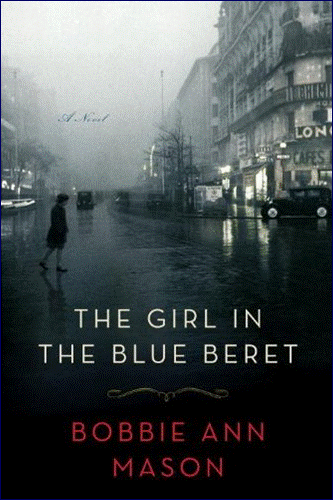
The Girl In The Blue Beret.


You can’t judge a book by it’s cover they say, but I did. It showed a rain slicked city street somewhere in Europe. Possibly Paris, I thought. The cars were 1930's vintage for sure. It was twilight with a slight fog hanging in the air. The street lights were aglow and there were few people about. Still a young woman , wearing a coat and a dark beret was crossing the street. The whole scene was somber, mysterious even a bit frightening. Something about it all made me think of Anne Frank.......
Thus, I was drawn into readomg author Bobbie Ann Mason’s new novel, The Girl In The Blue Beret,
I was so glad I judged that cover...
It is the story of a recently widowed American pilot, Marshal Stone, who is forced into mandatory retirement at the age of sixty and wondering what to do with the rest of his life. He is the same man, who as a young bomber pilot crash landed in 1944, on a mission over German occupied France.
Inspired by the experiences of her father-in-law, Mason tells a tale of war, love and survival in "The Girl in the Blue Beret" that alternates perfectly between World War II and modern Europe.
To the surprise of Marshall’s friends and family, he picks up and moves to Paris, intent on finding the ordinary people who hid him and led him safely out of France during the war after his B-17 crashed. Through his eyes, we meet members of the French Resistance who sacrificed greatly and often risked their lives to help downed airmen. We also learn about a cocksure young man slow to realize the high price of war to those who lived through it.
Mason's writing is exquisite. Not a single word is wasted or out of place, and she never drifts toward sentimentality — even in her descriptions of combat and the wreckage left behind. Her extensive knowledge of aircraft, combat and World War II is readily apparent, but isn't heavy-handed. Perhaps most impressive, though, is her ability to experience the world through a no-longer-middle-aged widower.
Filled with mystery, guilt and self doubt, courage, and romance, this book has it all. It shows people growing and changing, sometimes but not always for the better. How some stood up with courage under terrible circumstances. Not just another book about World War II, it will be the "quest" story you will never forget. I highly recommend it.

Saturday, August 13, 2011

Lost In Shangri-La


I love adventure/exploration/ survival stories. Needless to say, the newly published book Lost In Shangri-La fits those criterion exactly. One of the best of this genre I’ve read in a long time. From the New York Times Book Review
Picture of WAC Margaret Hastings & New Guinea Tribesmen
By MICHAEL WASHBURN
Published: June 3, 2011
"Adventure" these days is merely an experience that allows for a modestly elevated number of variables — renting a car without a GPS unit, for instance, or visiting a friend in East Flatbush. Not that the world is denuded of excitement. It’s just that true adventure requires something that defies an itinerary: failure. Failure is the engine of adventure.

Mitchell Zuckoff’s "Lost in Shangri-La" delivers a feast of failures — of planning, of technology, of communication — that are resolved in a truly incredible adventure. Truly incredible? A cliché, yes, but Zuckoff’s tale is something a drunk stitches together from forgotten B movies and daydreams while clutching the bar. Zuckoff is no fabulist, though, and in this brisk book he narrates the tense yet peaceful five weeks during 1945 that three plane crash survivors spent immersed "in a world that time didn’t forget. Time never knew it existed." Even at the level of exposition, the book is breathless.
In the final days of World War II, 24 bored soldiers and members of the Women’s Army Corps embark on an aeronautic joy ride over a newly "discovered" landscape — known today as the Baliem Valley — in the dangerously isolated mountains of New Guinea, mountains populated by thousands of combative "cannibals," where "a lifetime of war was an inheritance every child could count on."
Perhaps owing to a lethal combination of foolishness and inexperience, the plane crashes, eventually killing all aboard but a beautiful Wac and two all-American G.I.’s. They are unreachable except by parachute — or plane crash — and surrounded by startled warrior tribes; a contingent of Filipino-American paratroopers joins the survivors to aid in their rescue. With no place to land an airplane, the mountain air too thin for heli­copters, and the threat of thousands of hostile Japanese soldiers hiding between the injured group and the sea, Army commanders decide on the most reasonable extraction: a cargo plane with a big hook. At this point, you should know if Zuckoff’s book appeals to you.
The pleasures — and values — of this story reside in admiration of fortitude in a vortex of treacherous circumstances. It is the 1940s, though, so primitive sexual politics — Margaret Hastings, the surviving Wac, is repeatedly praised for her unexpected "gumption," and the Army’s first airdrop includes food, blankets and lipstick — abounds, as does the lazy racism of "cockpit anthropoligists even after the New Guineans prove indispensable. Zuckoff doesn’t editorialize, probably because this is an adventure tale; insofar as nobody can confront ingrained gender bias or cultural chauvinism while looking across a clearing at a war-­painted, spear-wielding expeditionary force, the book’s vitality derives from a contagious sympathy with its subjects’ circumstances. But it’s a fine line.
Technicolor chivalry and cultural atavism aside, "Lost in Shangri-La" tells of the first contact between disoriented, combative cultures, one of the final first-contacts in human history. It’s a tale of bravery, loyalty, trust and silly, often frightening miscommunication. For example, white sky gods figure prominently in the local eschatology, and unbeknown to the Americans, tribal leaders greet their arrival as a prophecy fulfilled. While the Americans run swap meets, debates rage over whether to kill the whites to stall the apocalypse.
Ultimately, Zuckoff’s story is heartbreaking. From the moment the New Guineans choose to aid the stranded Americans, their culture is jerked forward into a callous, evangelizing modernity. Each day, the American forces receive an airdrop, often containing weapons and cowrie shells — used as currency — inadvertently introducing two hallmarks of the modern West: firearms and inflation. Today, Zuckoff writes, "elderly native men in penis gourds . . . charge a small fee to pose for photos, inserting boar tusks through passages in their nasal septums to look fierce. More often, they look lost." By the end of Zuckoff’s narrative, it’s clear that the Americans, however painful and anguishing the ordeal, were hardly victims. After all, they experienced the thrills of adventure. The New Guineans, by contrast, inherited a tragedy.

Sunday, August 7, 2011

The Silent Man

I’m not a big fan of the "thriller" genre. That’s not to say though that I would never ever pick one up when I’m scanning the new novel shelf of our local public library. Alex Berenson’s thriller The Silent Man caught my eye. I read it.
The radical militants of the Middle East want to get their national, religious and personal revenge against the Americans. Their plot is obtain the elements needed to build a nuclear weapon, smuggle it into America and explode the device in Washington, D.C. How might they bring off such a scheme? How might our government's agents stop them? Alex Berenson's third John Wells thriller pits his CIA superhero against just such a plot Here is where I usually have trouble with thrillers. The super hero part is usually so hokey. On that point this book was to thrillers what reality TV is reality. Popular drivel. I'd already seen James Bond in the movies. I will say this tale is well written though in a descriptive sense. Berenson strings his plot together well and his adjectives do grab ones attention. The really intriguing part is where the author provides a realistic, detailed account of how the terrorists swipe two decommisioned nuclear "gadgets" from a Russian military base and transport them to the United States. There they are taken apart to patch together a nuclear bomb that could work. This is the part that caught my attention. I kept wondering if this kind of information should be available at Barnes and Noble.


We know in the end that superhero John Wells will save the world from a nuclear holocaust. What we don’t know is how plausable is the "science" behind the plot. Can a couple of amateurs build a nuclear weapon with a little luck, the right material and the internet. I think I became more and more convinced as I read this sophisticated account of the nuclear plot that it was not so far fetched as I thought. . Thrillers are supposed to be scary. It was. And that's what made it worth reading. In the real world lets hope our intelligence agencies are more prepared and aware than they were on 9/11.

Tuesday, August 2, 2011

The Final Storm


"War is hell."

William Tecumseh Sherman

Saturday, July 30, 2011

DAMN YANKEES

THREE NUNS WERE ATTENDING A YANKEES BASEBALL GAME. THEY WERE FROM MINNESOTA AND HOPED TO FIND OUT WHY THE YANKEES ALWAYS BEAT THE TWINS IN THE PLAYOFFS. PERHAPS THERE WAS SOMETHING TO THE MOVIE "DAMN YANKES" THAT THE DEVIL SUPPORTED THE NEW YORKERS.GAME.

THREE YANKEES FANS WERE SITTING DIRECTLY BEHIND.... BECAUSE THEIR HABITS WERE PARTIALLY BLOCKING THE VIEW,
THE MEN DECIDEDTO BADGER THE NUNS HOPING THAT THEY'D GET ANNOYED ENOUGH TO MOVE TO ANOTHER AREA..
IN A VERY LOUD VOICE, THE FIRST GUY SAID, "I THINK I'M GOING TO MOVE TO UTAH ...
THERE ARE ONLY 100 NUNS LIVING THERE.." THEN THE SECOND GUY SPOKE UP AND SAID, "I WANT TO GO TO MONTANA ... THERE ARE ONLY 5O NUNS LIVING THERE..
"THE THIRD GUY SAID, "I WANT TO GO TO IDAHO ..
THERE ARE ONLY 25 NUNS LIVING THERE.." ONE OF THE NUNS TURNED AROUND, LOOKED AT THE MEN, AND IN A VERY SWEET AND CALM VOICE SAID,
"WHY DON'T YOU GO TO HELL .. THERE AREN'T ANY NUNS THERE.

Wednesday, July 27, 2011

Tuttie Frutti

It had been a long hot day at the Minnesota Landscape and Horticultural Garden. We had gone with Mrs. T's cousin Joe and spouse Mary. Afterwards a dinner was in order at a local restaurant.

We all ordered a drink. Mrs. T: "I'll have that Hawaiian Special (or something akin to that)." Troutbirder: Beer, Leinis Honey Weisse, please." And then the song came flooding back in memory. Lil Richard singing...."A-Wop-bop-a-loo-lop a-lop-bam-booTutti Frutti, all over rootie,.....A-wop-bop-a-loo-lop a-lop bam booI got a gal, named Sue, She knows just what to do. .....I've been to the east, I've been to the west, but she's the gal That I love the best.Tutti Frutti, all over rootie,....A-wop-bop-a-loo-lop a-lop bam boo."
Some days I just can't help myself but on this occasion I didn't hold Mrs. T to her promise to take her turn and drive us home from the Twin Cities. :) That adult beverage must have been at least a quart.

Wednesday, July 13, 2011

Kids & Grandkids

TEACHER: John , why are you doing your math multiplication on the floor?
JOHN: You told me to do it without tables.
TEACHER: Glenn, how do you spell 'crocodile?'
GLENN: K-R-O-K-O-D-I-A-L'
TEACHER: No, that's wrong
GLENN: Maybe it is wrong, but you asked me how I spell it.
TEACHER: Donald, what is the chemical formula for water? DONALD: H I J K L M N O TEACHER: What are you talking about?
DONALD: Yesterday you said it's H to O.
TEACHER: George Washington not only chopped down his father's cherry tree, but also admitted it. Now, Louie, do you know why his father didn't punish him?
LOUIS: Because George still had the axe in his hand.
TEACHER: Now, Simon, tell me frankly, do you say prayers before eating?
SIMON: No sir, I don't have to, my Mom is a good cook.
TEACHER: Charles, what happens to your body as you age?


CHARLES: When you get old, so do your bowels and you get intercontinental.

TEACHER: Sally, how is dew formed?

SALLY: The sun shines down on the leaves and makes them perspire.

TEACHER: Bill, how can you delay milk turning sour?

BILLY: Keep it in the cow.


First Grandchild Ethan - Born Fargo North Dakota


Second Grandchild Tensae - Born

Ethiopia


Third Grandchild Leonard - Born Rwanda


Fourth Grandchild Vanessa - In process of adoption.